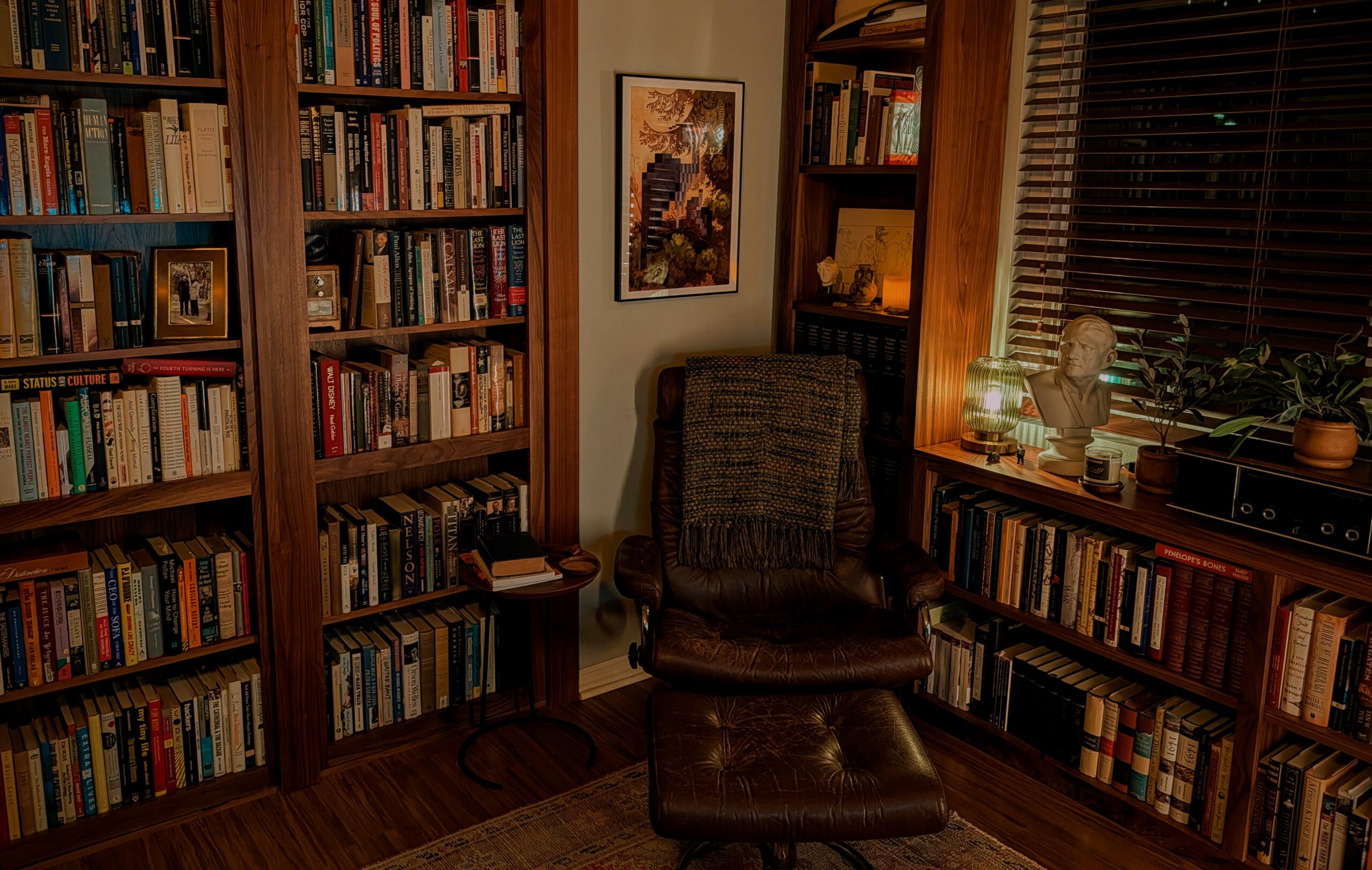
Oliver Wendell Holmes, in The Autocrat of the Breakfast-Table, holds that a child should have tumbled about in a library. He then offers the better and more knowing formulation:
“All men are afraid of books, who have not handled them from infancy.”
The fear subsides once we have learned that books are objects to be opened, marked, contradicted, misplaced, abandoned, resumed, and occasionally dropped on the floor.1 A person raised among them understands that they are not simply sacred furniture or instruments of examination. They are part of the ordinary equipment of a life.
The alternative is the ceremonial library: books bought by the yard, arranged by the color of their spines, in a room where no one is expected to read their titles. Such a room may be handsome. It is not a library. A library should show signs of appetite, accident, argument, and fixation. It should hold great works, useful works, foolish purchases, inherited mysteries, obsolete authorities, and a few volumes by whose presence the owner is slightly embarrassed.
For reading is not chiefly a means of accumulating books, facts, or approved opinions. It is a means of enlarging the range of one’s judgment. That enlargement requires more than reading often. It requires reading widely, deeply, and with discrimination.
Read Across the Shelves
One should read literature and history, poetry and politics, biography and philosophy—and know something of religion even if one is not religious, economics even if one finds economists tiresome, science even if the equations have become forbidding, and art even if one’s own drawings remain confined to the margins of meeting agendas.
No one will read everything, and no one should try.2 A lifetime spent finishing books out of obligation is a lifetime badly managed. But one should resist becoming a creature of a single shelf.
Fiction shows what it is to live inside another mind. History supplies the mortifying information that nearly every present certainty has had contrary predecessors. Poetry refines attention. Philosophy asks whether the assumptions beneath an argument can bear the weight placed on them. Politics demonstrates how badly philosophy survives contact with a committee. Biography reminds us that ideas occur inside vain, frightened, ambitious, loving, ridiculous human beings. Science enlarges the known world while regularly humiliating whatever portion of mankind had lately declared it settled.
These disciplines correct one another. The reader of politics without history becomes excitable, mistaking each week’s outrage for the first of its kind. The reader of history without literature may know what happened without understanding what it felt like to be alive while it did. The reader of philosophy without comedy begins to believe his system has no holes, which is the precise condition comedy exists to puncture. The reader of novels alone may grow exquisitely sensitive to the inner lives of imaginary people while being unable to make sense of a tax form or an instruction manual.
A proper education is not mastery of all subjects. It is enough familiarity with many of them to know when one has wandered beyond one’s competence—and enough curiosity to wander there anyway.
Read Against Yourself
One must also read beyond one’s own opinions.
This does not mean devoting equal time to every pamphlet, provocation, or professional grievance. Life is brief, and the supply of confident mediocrities is inexhaustible. Nor does it mean pretending every argument is equally sound. Breadth is not the suspension of judgment; it is the preparation for it.
The popular polemicists of any faction—the Carlsons, the Maddows, and their innumerable descendants and antecedents—are worth knowing about, chiefly because millions of one’s fellow citizens know about them. But they are tiresome creatures: simplified arguments delivered to audiences who have paid admission to hear their existing opinions applauded. Understand what they say without letting them occupy much shelf space.
The serious versions of their positions are another matter. Read the formidable socialist, the genuine conservative, the unembarrassed monarchist, the rigorous libertarian, the committed atheist, the serious theologian, the revolutionary, the reactionary, and the philosopher whose conclusions would produce a society out of which you suspect you would be among the first escorted, politely if you are lucky. The pure argument instructs more than the popular compromise: it reveals not merely what a position wants today, but what it believes the world fundamentally to be. Such writers may be wrong. They may be profoundly wrong. They may be personally distasteful, politically alarming, or possessed of views one would not even permit to govern the seating chart at dinner. Read them nevertheless, provided they have earned the time through seriousness, originality, influence, or force of thought.
To read only those with whom one already agrees is not inquiry. It is confirmation.
The same rule applies beyond politics. Read across centuries, countries, classes, religions, races, tribes, and sexes. A library composed only of people who resemble its owner is not a library of the world; it is a mirror. This does not require the construction of a perfectly representative shelf—reading should not become census-taking—but it does require noticing when every voice in the room has begun to sound like one’s own.
Other lives are not medicinal supplements to be swallowed for moral improvement. They are part of literature itself. They show that what one took for human nature may have been only the custom of one’s neighborhood.
Read What Is Beautiful
Breadth is not enough. One must also read beautiful things.
A book can be intelligent, humane, historically important, morally serious, and badly written. We may be grateful for it without pretending the sentences sing. There are excellent novelists whose strength lies in social understanding, psychological acuity, comic energy, or the sheer inhabited abundance of their worlds. We should read our Bellows, our Roths, our Morrisons, and our Sinclairs; they tell us things worth knowing, and at their best they tell them with great power.
But room must be made—and perhaps a higher room—for the writers whose style does not merely carry the work but completes it: Cather’s austere light, Fitzgerald’s doomed shimmer, Updike’s overripe precision, Maclean’s river-polished cadences. These writers remind us that the manner of saying is not ornament added to the thing said. In literature, the sentence is the thought in its final form.
Style without substance is perfumery. Substance without style is a memorandum. The great work abolishes the distinction.
Beauty is not prettiness. Flannery O’Connor is beautiful, though her beauty often arrives carrying a wooden leg or a stolen Bible. Aeschylus is beautiful amid inherited murder and generational vengeance. Melville is beautiful while discussing whale oil. Beauty is the achieved form through which the work becomes fully and unmistakably itself. The reader who attends only to the message will miss it; the reader who wants only plot will run past it; the reader trained to ask solely whether a work is agreeable will notice everything except the beauty. Read slowly enough, at least sometimes, to hear the sentences.
Find Your Authors
Wide reading eventually produces something narrower and more personal: the discovery of the writers who seem to have been waiting for you.
Certain authors do more than impress us. They recognize something we had not yet put into words; their preoccupations become entangled with our own. We return to them not because they are always comforting, or even always right, but because they have established territory inside us.
For me they include Walt Whitman—who is, to my mind, the greatest of the poets, and who speaks to my soul as directly as if he had written for it alone3—along with Kazuo Ishiguro, Willa Cather, Flannery O’Connor, and Ken Kesey, especially the Kesey of Sometimes a Great Notion. They are not much alike. Ishiguro is controlled where Kesey surges; Cather clarifies where O’Connor ambushes; Whitman throws the doors open where the others choose their rooms with care. Yet each reaches some private territory: restraint, place, duty, self-deception, family, pride, grace, and the human talent for arranging an entire life around a truth one refuses to face.
Find your own such writers and read them deeply. Read past the famous book—read too the early work and the late, the failure, the essay, the correspondence, the one critics agree may be skipped. Reread them at different ages; a novel met at twenty-five is not the same novel at forty-five, because the reader has changed in the meantime and brings a different self to the page. There is no shame in obsession. A library should contain evidence that its owner has gone too far into something.
In my own case the something is ancient Greece, which I am aware is the most exhausted marker of cultivation available, the default enthusiasm of every man who has ever owned a leatherbound book, and I claim it anyway: Aeschylus, Sophocles, Herodotus, Thucydides, Xenophon, and the philosophers—Plato, by God, Plato. Here are tragedy, history, war, democracy, rhetoric, citizenship, tyranny, honor, vanity, and the still-unsettled question of whether human beings can govern themselves without eventually putting Socrates to death. Another reader may find the same inexhaustible pull in medieval theology, the American West, the Mughal court, Russian poetry, maritime history, or the domestic novel. Follow it. General cultivation is admirable; particular devotion is what makes a library belong to someone.
Leave Room for the Small Book
The great names should not crowd everyone else from the room.
Canons are useful. They preserve works that generations of serious readers found inexhaustible. They also accumulate blind spots, politics, and institutional inertia. The proper response is neither obedience nor demolition: read the canon, then read around it, beneath it, against it, and past the point where its keepers stopped paying attention: the years, countries, and kinds of book it never thought to include.
The obscure philosophical essay, the regional poet, the small-press novella, the neglected memoir, the strange little book found on a table in a shop: any of these may matter more to a particular life than the annotated monument assigned in school. Read Byung-Chul Han’s slim provocations, or Simone Weil’s, or Emil Cioran’s cheerful counsels of despair. Read poets from your own region and time, especially those who notice the landscapes you move through without seeing. Read the book whose audience appears to consist of three professors, a retired architect, and you.
Small presses publish nonsense too, sometimes under exceptionally handsome covers. But intellectual life goes sterile when confined to books already certified as important. The unknown book still holds the possibility of private discovery: no reputation has arrived ahead of your own judgment to declare worthiness.
There Are Good Books and Bad Books
Here a polite contemporary essay might conclude that all reading is equally valid, that no book is better than another, and that whatever works for you is beyond criticism. I demur.
Whatever works for you is allowed, if only begrudgingly. One may read a bad thriller on an airplane, a sentimental novel through an illness, or a celebrity memoir at the beach.4 Pleasure needs no tribunal, and no one is required to spend every evening improving his soul beneath a green-shaded lamp. But indulgence is not judgment.
There are good books and bad ones. There are precise sentences and slapdash ones, breathing characters and mechanical devices, earned emotion and manipulation, genuine thought and secondhand profundity. There are works whose popularity reflects real narrative power, and works whose popularity reflects publicity, fashion, wish-fulfillment, or the public’s permanent wish to be reassured written with the vocabulary of an eighth-grader.
To say standards exist is not to claim that every judgment is objective, final, or uncontested. Taste develops through argument; intelligent readers disagree, and the same reader disagrees with himself ten years later. None of this makes discrimination impossible. It makes it difficult. Ask what a book attempted, how fully it achieved it, whether its language is alive, whether its characters exceed their functions, whether its ideas survive scrutiny, whether its effects were earned, and whether the work grows larger on rereading or merely more familiar.
Popularity may be evidence of pleasure; it is not proof of quality. Prestige may be evidence that serious readers found value; it is not proof either. Read the book, then render judgment.
Some Hard Books Are Great
Some great books are difficult. They may ask for historical knowledge, patience, annotation, surrender to an unfamiliar form, or simply the humility to admit one has not understood the previous six pages after reading them several times. Difficulty can be part of what a book gives: the mind learns new motions, attention strengthens, and a work at first opaque begins to disclose an order invisible to a hurried reader. A book can change a life partly because it demanded that the reader become capable of receiving it.
But difficulty proves nothing on its own. Some difficult books are badly organized, or poorly translated, or built on unexplained specialist language, or possessed of one strong thought stretched across three hundred pages. Some conceal uncertainty beneath abstraction, and some conceal emptiness beneath uncertainty. A lengthy sentence is not profound merely because it must be read five times to determine whether it contains a verb.5
And difficulty is no more a merit than obscurity is. The small press and the forbidding masterwork fail in the same way when they fail: a book is not good because few have read it, nor because few can. Persist beyond initial resistance, but you are not obliged to persist forever. Abandoning a book may be laziness, and it may be judgment; the art lies in telling the difference, and no method quite removes the temptation to flatter oneself. Give acknowledged greatness more patience than novelty. Give an alien form time to establish its laws. Consult the introduction if at first you struggle. Read a few pages aloud. Find a better translation. Return in a few years. But do not confuse incomprehension with revelation. Some great books are hard. Some hard books are merely hard.
Read Without Fear
Reading widely does not mean reading indiscriminately. Reading deeply does not mean reading solemnly. Reading seriously does not require treating books as relics. Mark them. Argue in the margins. Fold a corner, provided the volume is yours (or no librarian can see you). Read several books at once. Abandon one, return to another, memorize a passage, forget the plot, change your mind. Discover that the author you once worshipped is smaller than you remembered, or that the book you dismissed at twenty has been waiting for you to acquire the necessary sorrows.6
The purpose of reading is not to become a person who has read certain books. It is to become harder to deceive, more capable of attention, less imprisoned within one’s own experience, and more alive to beauty when it appears.
A good library does not prove that its owner is cultivated. It assists in the cultivation.7
Notes
- I write this with authority. My ten-month-old, having lately mastered the noble art of grasping an object and then letting it go, has appointed himself chief adversary of my lower shelves. He cannot yet read, but he has already grasped the most important lesson a library teaches: that a book is a thing you take down and do something with. He applies that lesson with a rigor I can only admire, one volume at a time, each landing on the floor. ↩
- Umberto Eco kept a famously large personal library, most of it unread. Nassim Nicholas Taleb, in The Black Swan, took Eco’s shelves as his model and gave the idea a name—the antilibrary: a collection whose unread books stand for everything one does not yet know. The menace of the growing unread shelf is not a reproach. It is the whole point. This should not be read, however, to license the decorative shelf: the antilibrary is unread because one has bought faster than one can read, which is a form of appetite; the ceremonial library is unread because reading was never the intention, which is a form of furniture. The shelves look identical; only the owner knows which he has.↩
- But of course he writes for us all; for what he assumes we shall assume; every atom belonging to him as good belongs to me and to you. ↩
- The bathtub, I will argue in a later dispatch, is reserved for good literature and a well-made Manhattan—among the few things improved by hot water and solitude. A celebrity memoir would sully the entire enterprise. ↩
- With apologies to Mr. Faulkner, who could sustain such a sentence across most of a page and arrive, against all odds, at the verb, and at something worth the wait. The rule holds; he is the exception that makes one nervous about stating it. ↩
- Francine Prose, in “I Know Why the Caged Bird Cannot Read,” made the related and unpopular observation that we hand The Great Gatsby to sixteen-year-olds who have not yet lived enough to be wounded by it, then wonder why they find it boring. Some books are wasted on us not because we are stupid but because we are, mercifully, still innocent. ↩
- A library on open shelves is also a kind of vanity—but the Snoot is vain enough to hope you leave it having learned something. ↩