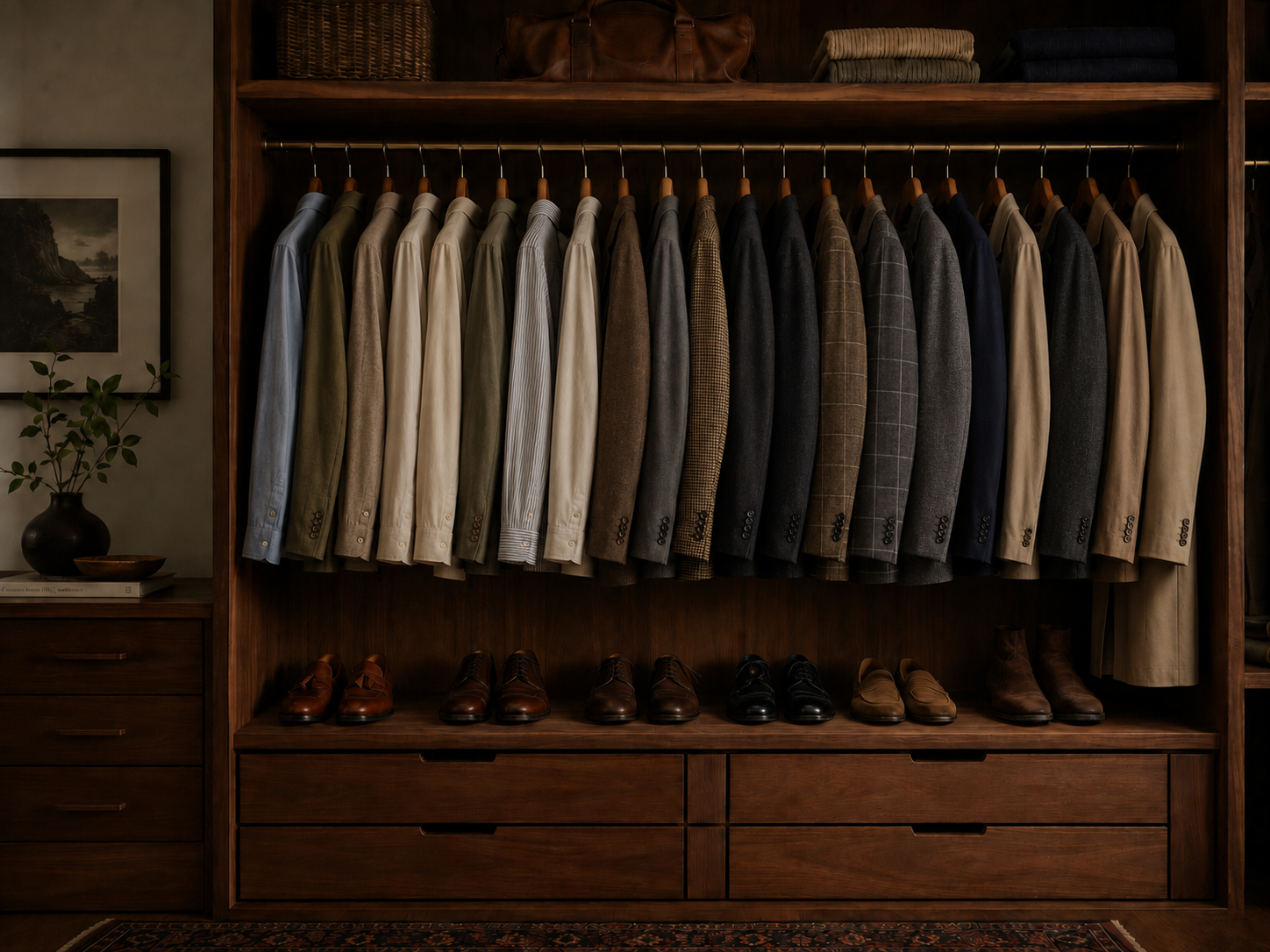
Clothing is not the most important thing about a person. This is fortunate, since most people are badly dressed. A kind and brilliant man may live beneath a synthetic quarter-zip, and a scoundrel may keep an excellent tailor. But while clothes do not establish character, they do announce judgment, self-knowledge, and respect for the occasion—along with a general capacity to distinguish being comfortable from having surrendered.
One’s aim should not be to become fashionable. Fashion is a commercial weather system: useful to observe, foolish to obey, and certain to move on shortly after one has spent too much accommodating it. The aim must be to dress well, which means clothes suited to the occasion and clime, clothes that fit, clothes made where possible from natural materials, shoes that do not ruin the whole, and accessories that add interest without becoming the point. Above all it means appearing—and ultimately being—at ease: as though the clothes belong to the life being lived, rather than the ones a man would default to if he slept through it. This is not effortless. It should merely look that way.1
Dress for Where You Are Going
The first question is not whether an item is attractive but whether it is correct for the circumstances. A dinner jacket is excellent at a formal evening and deranged at a farmers’ market. A linen shirt is admirable beside the Mediterranean and less convincing during a sleet storm in Edinburgh. Hiking boots belong on a trail and should not become one’s standing reply to the existence of pavement. A cashmere overcoat on a cold evening is elegant; the same coat over an August wedding is not, however beautifully the wearer is determined to suffer.2
A few workable outfits, for starters. For a summer lunch: an unstructured linen jacket, a cotton or linen shirt, lightweight trousers, loafers—the fabrics breathe, the construction is relaxed, and the formality is sufficient without becoming theatrical. For business: a dark wool suit or a tailored jacket, a crisp shirt, and proper leather shoes, which communicate seriousness without requiring explanation. For the weekend: a good cotton Oxford, straight trousers or well-fitting denim, and loafers, boots, or plain leather shoes will carry a person through most civilized activity.
For actual exercise, by all means wear exercise clothes; one need not play tennis in flannel to make a point about good taste. But clothing designed for exertion should remain connected to the possibility that exertion may occur.
This brings me, reluctantly, to athleisure. It offers the appearance of readiness without the inconvenience of intention: compression fabric, plastic sheen, technical panels, and elastic waistbands accompanying their owners to brunch, airports, restaurants, and other places where no one is expected suddenly to perform a lunge. The result is most perverse in actual leisurely environments, which ought to imply ease, pleasure, and the possession of time; athleisure implies instead that one may be summoned at any moment to conduct a warm-up drill in a hotel lobby. Wear it to the gym. Wear it while running. Do not let it become the uniform of your entire non-working life.
Nothing Survives Bad Fit
A modest garment that fits will defeat an expensive one that does not. This is among the few absolute laws of dress.
A jacket should sit cleanly across the shoulders, its collar close to the neck rather than standing away as though offended. Sleeves should end deliberately, not somewhere in the vicinity of the hands. Trousers should hang cleanly, neither clinging to the calf nor pooling above the shoes in folds that suggest the wearer has recently shrunk. The same principles govern women’s clothes, though on them I claim no expertise beyond the conviction that a garment should follow the body without fighting it; the specifics I leave to those who know them. Tailoring should create line and proportion, not punishment.
Many confuse tightness with fit. Tight clothing is merely close to the body; well-fitting clothing gives the body shape and room, hangs properly when one stands, and stays composed when one sits. Others confuse looseness with ease—but a loose garment should still be cut intentionally, its fullness deliberate rather than accidental. There is a difference between a generous drape and a garment that appears to be awaiting its rightful owner.
Learn where alterations are possible. Hems, waist, sleeve length, and minor adjustments can transform ordinary clothes; shoulders, armholes, and the fundamental structure of a garment generally cannot be corrected economically. Buy the structural parts correctly and let a tailor attend to the rest.
Insist on Natural Materials
Natural materials are, as a rule, the good ones—provided they are asked to do work they are suited for, which is why one does not commission a linen overcoat or a tweed swimsuit. Their advantage is that they behave like materials rather than packaging. Wool drapes. Linen breathes and wrinkles. Cotton softens. Leather creases, darkens, and records use. These are not defects to be engineered away; they are the reason the material is worth having. A wool jacket should have some movement, linen should not be pressed into the rigid condition of a laminated menu, and leather shoes should crease where the foot bends, because feet bend and honest shoes admit it.
The garment industry has spent enormous effort persuading people that these signs of life are failures, and so we are offered shirts that resist wrinkles, trousers that repel weather, and knitwear engineered to outlast the person wearing it. Most of this is plastic. Polyester, nylon, acrylic, and elastane have their narrow uses—technical fabrics belong in rainwear and on mountainsides—but they have no business impersonating cloth in a shirt or a suit, and I want my trousers cut from cloth, not spun from petroleum.
I will begrudgingly allow that a well-cut garment of blended fibers can look respectable, though the admission is made without enthusiasm. Such things should be bought only when budget genuinely forbids the alternative. A person starting from nothing need not bankrupt himself chasing handwoven cashmere, and a well-proportioned cotton-blend jacket beats an ill-fitting pure-wool one. But look harder before conceding. Buy less, wait for sales, consider secondhand, seek out older garments made before plastic became the default answer to every question, and save for the better coat rather than buying three inferior ones. Patience is cheaper than regret, and dresses better.
Some Expensive Clothes Are Better
Price and quality are not the same, but neither are they strangers. In tailoring especially, better construction genuinely costs more, because it demands better cloth, more skilled hands, and more time; a well-made jacket is built to drape naturally and to improve with wear, where a cheap one is glued together and begins dying the day you buy it. Good shoes justify their cost the same way, while cheap shoes turn expensive through replacement.3 Coats, knitwear, tailoring, and footwear are therefore sensible places to spend more—provided the extra money is buying cloth and craftsmanship rather than the privilege of advertising the label.
For luxury houses understand that many customers are not buying quality but recognizability. Loro Piana and Brunello Cucinelli, to pick two names entirely at random, make beautiful cloth and some genuinely beautiful clothes; they also sell plain T-shirts and ball caps at prices suggesting cotton has lately become a controlled substance. Gucci will at least have the courtesy to put its name on the outrage, so you know what you paid for. In every case the object may be perfectly good but the ratio between its quality and its price still outrageous. A well-constructed suit can represent real value over decades; a four-figure baseball cap represents a person’s wish to be noticed by precisely the sort of person who recognizes four-figure baseball caps.
Logos Are a Confession
A visible logo asks strangers to admire the transaction. The larger the logo, the less confidence one should place in the wearer’s judgment.
There are honest exceptions: a small maker’s mark, a discreet emblem on sporting equipment, the traditional insignia of a club or institution. But the billboard chest, the repeating monogram, the house name stretched across a sweatshirt, and the bag so thoroughly patterned with initials that it resembles branded wallpaper are not design. They are receipts, worn externally. Be suspicious of any garment whose principal feature is the name of the company that sold it. The genuinely fine article does not announce its manufacturer; the cloth, cut, and construction reveal themselves to those able to notice, and those unable to notice need not be told. There is relief in this: you are not required to buy the most famous or expensive thing, only the best one you can reasonably afford. The quieter garment leaves more room for you to be the visible part.
Dress a Step Above
Aim to be at least half a step better dressed than the room—and often a good deal more. Not, as a rule, several flights above it, since the object is neither to embarrass one’s companions nor to appear to have misread the invitation, but to show a little more care and a slightly better eye: a knitted polo where others wear printed tees, a jacket that actually fits, linen trousers rather than gym shorts. Dress, instead, for the tone of the occasion you wish to be part of.4 A room often lifts slightly when one person has bothered; standards are contagious in both directions.
And there is no shame in outdressing a room that has not tried. If you find yourself the only adult among a congregation of cargo shorts and slogan tees, do not apologize by dressing down to meet them; a man who has come correct and carries it without fuss is never overdressed, whatever the slobs around him may privately suspect. The trick is entirely in the carrying: the same jacket reads as arrogance on a man who keeps checking whether it is admired, and as simple self-possession on one who has forgotten he has it on.
Still, beware of appearing to have tried too hard—an annoying caution, since dressing well plainly takes effort. The distinction is not between trying and not trying but between effort absorbed into the whole and effort left visible on the surface. Clothes look overworked when every element demands its own recognition: the aggressive tie, the ornamental socks, the conspicuous cufflinks, the lapel pin, and shoes in a shade ordinarily reserved for sports cars. Each may be defensible alone; together they form a cry for help. Even so, the opposite error is the more common one. Fear of overdressing is among the leading causes of underdressing, and one must not become timid. It is entirely acceptable to stand out for having dressed well; the thing to avoid is standing out for appearing desperate to be known as someone who dresses well. Let others notice. Do not help them.
The Rules, and Their Breaking
Everything above is a rule, and every rule here can be broken—provided you know precisely which one you are breaking, and why. The man who wears brown suede with a navy suit in defiance of an older prohibition, and does it beautifully, has not violated the spirit of dress; he has understood it well enough to overrule a clause. But this license is earned, not assumed. One must know the rule, know the reason behind it, and be able to say what one gains by setting it aside. The novice who ignores a rule he never learned is not being original; he is merely undressed in a new place. Break the rules once they can no longer intimidate you. Until then, they are rules for a reason, and the reason is usually that they are right.
Wear the Clothes
The final requirement is the one that has been underneath all the others: ease. It is not the same as casualness—a person can be entirely at ease in white tie and wretched in sweatpants—but is simply the absence of visible negotiation between the wearer and the clothes. Do not tug at the jacket, adjust the cuffs every thirty seconds, announce the maker, explain the fabric, or mention what any of it cost.5 Having chosen the thing, inhabit it. The clothes should permit ordinary human behavior—sitting, walking, eating, laughing, occasionally forgetting what one has on—and a garment that must be continually protected from the life around it is probably unsuited to that life.
Confidence helps, and it comes not from the mirror but from familiarity: clothes that fit and suit the setting remove the uncertainty, and wearing them often does the rest. A man who wears a jacket weekly looks more at ease in one than a man who puts it on only for weddings and court appearances. This is why a wardrobe should develop rather than arrive all at once. Wear things, learn what works, alter what nearly works, and discard what does not. Personal style is not the assembly of a costume. It is the slow elimination of everything false.
Dress for the occasion. Respect the climate. Insist on fit. Prefer natural materials. Spend where construction matters. Avoid the logo. Let wool drape and linen wrinkle. Stand a step above the room without climbing onto a platform. Wear the clothes, and do not let the clothes wear you.6
Notes
- The paradox of dressing well is that visible effort defeats itself. The goal is to look as though you woke up correct—an illusion that, like most good illusions, takes considerable work to sustain. ↩
- Some latitude is allowed here, particularly between adjacent circumstances; the line between a relaxed business day and a dressy casual one is not policed, and a single outfit may cross it without alarm. It is the gross mismatch—the tuxedo at the market, the gym shorts at the funeral—that offends. ↩
- The specifics—fused versus canvassed construction, surgeon’s cuffs, the anatomy of a welted shoe—reward more attention than parentheses can give them, and will receive it in a dispatch of their own. For now it is enough to know that the good version is sewn and the cheap version is glued, and that glue always loses in the end. ↩
- This is the respectable cousin of the vulgar instruction to dress for the job you want—broader, and less mercenary. ↩
- The parallel to a certain first-class airline passenger, discussed in our opening dispatch, is exact. The man who explains what his jacket cost has told you the one thing about it he should have kept to himself. ↩
- Future dispatches will take up particular occasions, garments, materials, tailoring, footwear, and accessories, along with the vexed question of what a grown adult should wear to an airport. For now it is enough to begin with honesty, proportion, and the firm resolve not to attend brunch dressed for a triathlon. ↩