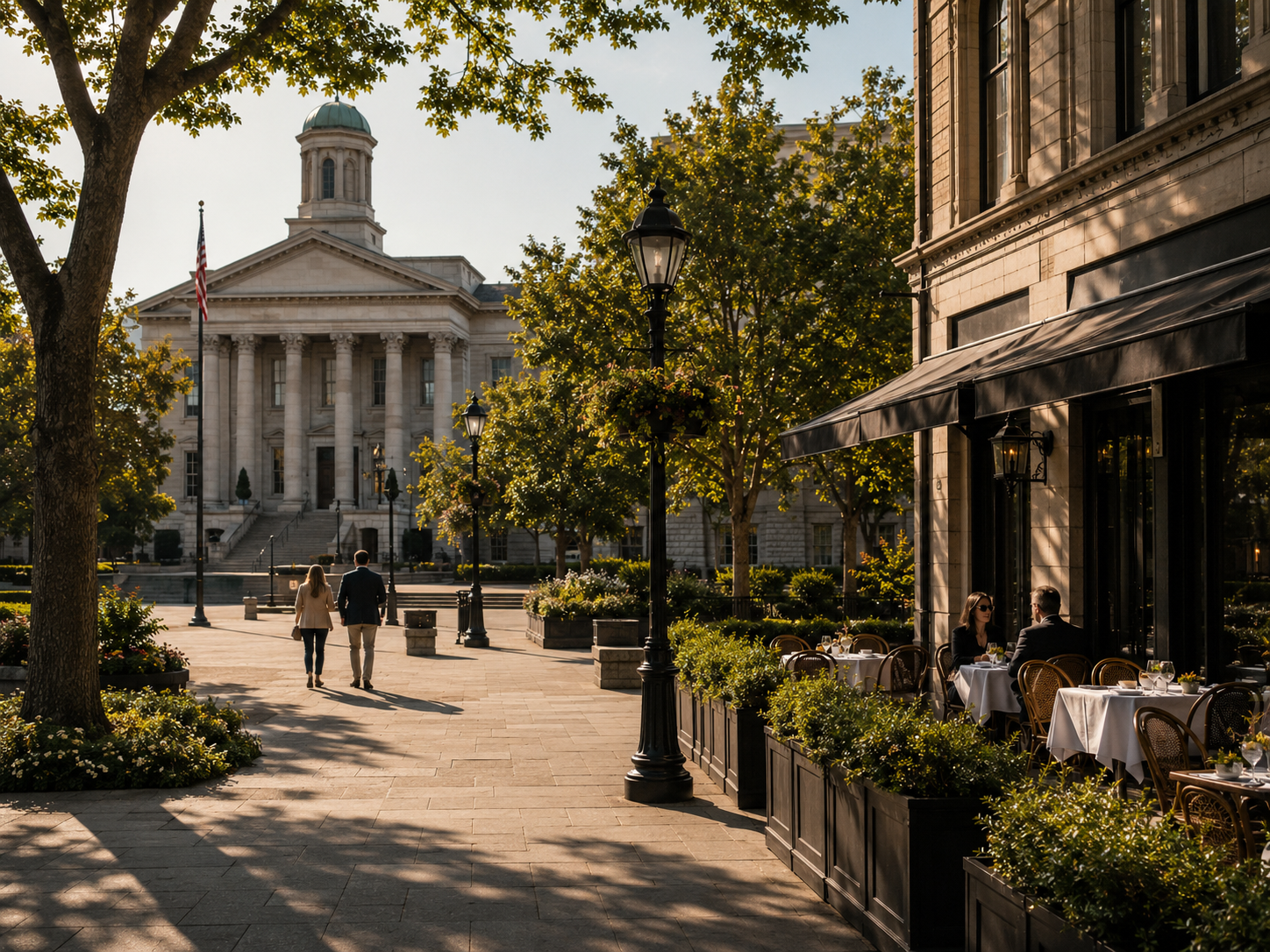
A town is more than the buildings closest to one’s house. It is the streets, shops, restaurants, libraries, parks, and bars through which private lives become public ones. At home, one arranges the world to one’s own satisfaction. Out the front door, that authority ends. Other people have preferences, schedules, dogs of their own, and shopping carts parked diagonally across the aisle; living among them well is a distinct skill: manners, curiosity, patience, and the occasional suppression of a cutting remark.
The temptation, once one has the means to avoid all this, is to withdraw from it—to conduct life entirely behind a handsome front door, ordering in what used to require going out. About Town is written against that temptation. A man who has drawn everything he needs from a place and given nothing back to it has achieved insulation, not success, and a life lived at that distance from one’s own town is a smaller life than the house it is conducted in.
These pages will therefore concern themselves with conduct in the shared world: how to be a decent neighbor and a tolerable colleague; how to know what is genuinely distinctive about where one lives, and tell it from what merely imitates distinction; how to choose a restaurant and sit in it with neither intimidation nor performance; and what one owes the public world once one has enough means—of any kind—to be useful in it.
Among the Neighbors
Neighborliness fails in two directions: the one who treats proximity as though it had made everyone family, and the one who regards the sight of another human being near the bins as a security incident.1
Proper neighborliness, ours as much as theirs, should moderate between these extremes, and consist of recognition without intrusion. Say hello. Learn names. Take in a package. Move the branch that has come down across the shared drive. Keep a companionable eye on the house next door without developing theories about what happens inside it. One need not become intimate with everyone within a given radius—the modern insistence that every relationship resolve into either friendship or hostility has done enough damage—and a neighbor may simply remain a neighbor: someone toward whom one holds modest but real obligations, sharpened by proximity and the knowledge that either household may one day need a ladder or a jump-start. (Being a good guest, when the invitation comes, is an art of its own and will have its own dispatch.)
Be mindful that proximity generates friction, and noise is often where it shows first. Music, children, and the weekend repair project are all part of life, but one’s enthusiasm for a song does not survive its transmission through the party wall at one in the morning. The same holds for parking, smoke, trees, fences, and the small territorial disputes through which otherwise reasonable adults locate their inner feudal lord. Much of this is why a little distance between houses is worth paying for—a hedge, a side yard, a few feet of air—since the finest manners in the world are no substitute for air gaps and walls thick enough to keep one’s enthusiasms to oneself.
Work Among Others
For most people the workplace is the public arena that consumes the most waking hours, which earns it manners beyond the cheerful tyranny of the motivational poster. Arrive prepared. Answer your messages. Credit other people’s work as freely as your own. Do not call a meeting that could have been an email, or send an email so opaque it breeds three meetings.2 Learn the names of the people who keep the place running, particularly when their work is less visible than yours. Hierarchy may be necessary; high-handedness never is.
Here the failures come in a matched pair: the manager who thinks authority is proven by making subordinates uncomfortable, and the subordinate who thinks independence is proven by making cooperation impossible. Both are exhausting, and competence with a little steadiness outlasts both. The rest is unglamorous and non-negotiable—do not eat a colleague’s labeled lunch, do not hold a speakerphone conversation in a shared room, and dress in a way that acknowledges the work and the people obliged to look at you without turning the office into a daily referendum on your taste. Office friendship is a real good; office gossip is inevitable; knowing useful context from reputational vandalism is most of what it means to be a grown-up at work.
Knowing Your Own Ground
Moving on, some people know three distant capitals better than the city outside their window—they can name a café in Paris and a viewpoint above Florence, yet have never entered the historical society two miles away or worked out why their own main street bends where it does. Travel is meant to broaden the mind, and Elsewhere will have a great deal to say about doing it properly; travel is not meant to leave the ground beneath one’s feet a blank.
To live somewhere well is to grow curious about it. Learn the landscape that decided how the place grew—the river, shore, hill, or fault—and learn who built it, who was displaced to build it, what industry made it and what failed. Go to the museums, the old market, the independent bookshop, and the restaurant serving the one dish you could not quite get anywhere else. Attend the odd local festival, and the occasional council meeting.3 Every town does one thing better than outsiders expect and one celebrated thing worse, and a person who knows his ground can tell you both.
That knowledge is also what lets one tell the real from the “premium,” because many towns now assemble replicas of others. The market hall built last year, full of distressed brick and a mural composed for the camera, sells four versions of the same expensive sandwich; the arts district contains no working artists but a great deal of signage announcing that it is an arts district; the neighborhood tavern belongs to an investment group operating eleven others across four counties. Some of these places are pleasant enough, and new things do become real, through affection and over time. But the genuine place has reasons for its peculiarities, accumulated over years, where the manufactured one starts from the appearance of accumulation and works backward from an opening date.
The same knowledge makes you useful when a visitor comes. Do not march him to the attraction listed first on every website—show him the dish that tells him where he is, the street where the architecture becomes itself, the industrial relic that could not be moved elsewhere without turning false.4 Excellence and character are related but not identical: a restaurant may be technically flawless and interchangeable with six like it in other cities (all operated by that same investment group), while the old counter with the local specialty tells him something he could not have learned at home, even where the coffee is an ordeal to be survived.5 And do not spend the visit apologizing for the place. There are two provincialisms—believing one’s town the center of the world, and believing the center is always somewhere else—and the second is the more fashionable without being any less provincial.
Eating Out
It is worth providing a note on the important role restaurants play in knowing your town, as a town’s restaurants can say as much about it as its architecture does. The restaurant most anxious to be recognized as good is often not the good one. A serious place is coherent: what the kitchen attempts, what the room costs, and what the staff have been trained to do all point at the same evening. Expense is not the enemy—there are nights when fine linen and a deep cellar are exactly right—but the most expensive restaurant in town is very often not the best, particularly where the clientele has come to be seen spending rather than to eat. A room full of people who cannot taste the difference will not, in the long run, be served food that requires them to.
When eating out at fine restaurants, do not be intimidated; you have come to eat dinner. Ask questions when they are real questions and listen to the answers. Familiarity is welcome and performance is not, in either direction—obsequious service should make everyone uncomfortable. Give the sommelier your budget plainly if you are partaking. And when something is genuinely wrong, say so at once, so it can be put right. A raw chicken is not a difference of opinion.
Then, provided the restaurant is good, go back, and keep going back. Do that long enough and you may become a regular, a status conferred rather than claimed. The true regular has simply returned, behaved well, tipped properly, and taken an interest in the people who work there. The false regular announces the condition and refers to a small alteration of the menu as “what they do for me.”
The Public World
On a more meaningful note, a town also includes the things no one owns despite everyone relying on them: the street, the park, the library, and also the unseen storm drain and water main. These lack the glamour of private consumption right up until the moment they fail, at which point nothing else in the world matters quite as much.
There is a lately fashionable figure—the techno-libertarian, the anarcho-capitalist, the man who regards everything held in common as inherently suspect—whose entire life quietly rests on public achievements he has trained himself not to see. He would opt out of society while keeping the roads, the clean water, the enforceable contracts, and the settled arrangement by which his rubbish leaves the house without anyone having to think about it. One can grant him his real point: government is sometimes wasteful, slow, and occasionally absurd. So too, however, are corporations, universities, families, and private charities planning galas; disrepair is an argument for investment, not for pretending the shared thing was never shared. The public realm is what we hold in common, and its condition says plainly what a community thinks everyone deserves, including those who cannot buy a private substitute.
Which yields the one obligation in this category on which I am entirely serious. A person who has taken more from a place—in money, in opportunity, in the quiet advantages that compound over a life—owes more back to it, and the debt is payable in several currencies: money, skill, time, and influence all spend perfectly well on the common world.6 This need not turn every dinner into a policy seminar. The man who runs every conversation back to whatever happened at the local Council this week is a bore.
The practical form of all this is simply taking part. Patronize the good local business. Join something. Subscribe to the local paper, if it still contains reporting. Learn the name of the bookseller, the bartender, the librarian whose judgment quietly improves your week. Participation creates attachment, and attachment creates responsibility: the town stops being a backdrop and becomes a relationship—imperfect, recurring, occasionally expensive, and hard to abandon without the sense of having left something unfinished. None of this requires loving every feature of the place. Affection without criticism is tourism-board copy; criticism without affection is a hobby for people who should relocate. Citizenship is not measured in constant indignation but in sustained participation—and then one may, with a clear conscience, speak of something else before the soup arrives.
What About Town Will Cover
About Town will range across neighbors and the keeping of them, work and its manners, the knowing of one’s own ground, restaurants and how to sit in them, and the public world and what is owed to it. It will demonstrate how to express familiarity without presumption, service without servility, confidence without condescension, and local pride without boosterism. It will have rather less time for the restaurant concept than the restaurant itself, the manufactured district than the neighborhood that grew, and the civic opinion unaccompanied by any civic participation.
A town is a shared achievement, though the shares are not evenly handed out and the achievement is often visibly unfinished. To live in one well is to notice what is distinctive, understand what is held in common, and accept some responsibility for both. Society begins outside the home. About Town will cover how to make it civil.
Notes
- My mother-in-law belongs firmly to the second party. A wave from across the street is not a greeting but an overture, and somewhere behind it is a request she has already resolved to decline. ↩
- Special condemnation is reserved for the bodiless “see me” to one’s subordinate, sent at 4:40 on a Friday, containing no subject, no context, and no clue—a message whose entire content could conceivably be the recipient’s weekend, now ruined. Whatever it is, it could have been said in the message. ↩
- Occasional. The council meeting is a civic duty best taken in small doses, since a sufficiently long session of public comment will damage one’s estimate of the public, one’s neighbors, and eventually the whole democratic experiment. ↩
- Credit where due: the review sites can often be perfectly correct about the famous things, which are famous for reasons. Your value to a visitor is not in contradicting them but in knowing the other half—the places no algorithm has yet found a way to rank. ↩
- Though let no one mistake this for a general amnesty on bad coffee. That the counter has character does not oblige you to enjoy what it pours, and a place serving genuinely terrible coffee should be told so, gently, by someone who comes in often enough to have earned the right. ↩
- Cicero called it the res publica, the public thing: not the government but the commonwealth itself, everything owned in common by a people. He held that those who had prospered owed it most, and that withdrawal into private life was not modesty but desertion. He was, admittedly, later proscribed and beheaded by men who had withdrawn from nothing—so the record on this is mixed. He was nevertheless right. ↩